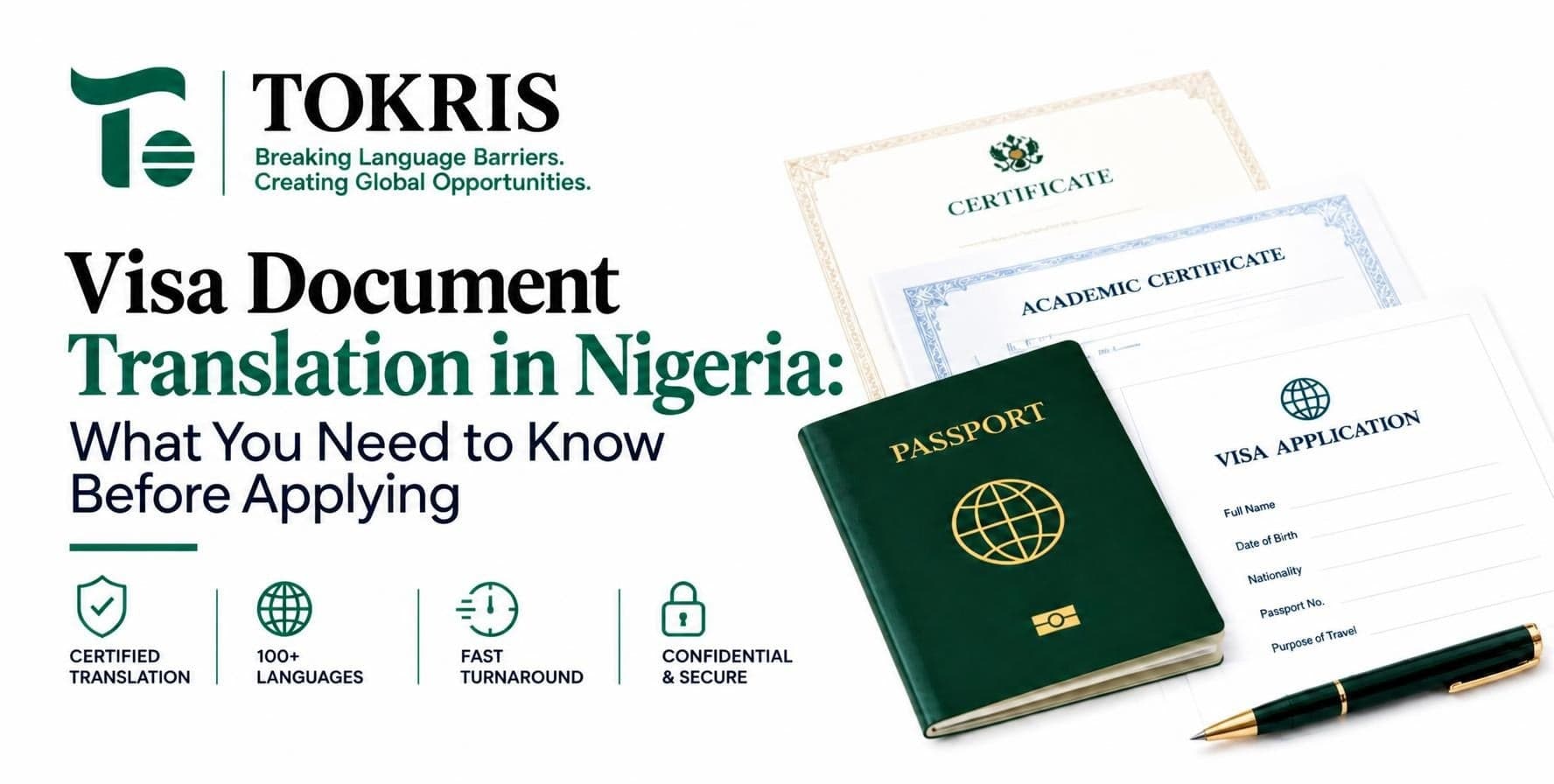
Visa Document Translation in Nigeria: What You Need to Know Before Applying
Applying for a visa and need your documents translated? Learn which documents may require translation, when certification may be needed. How the process works and how Tokris Global Services can help with professional visa document translation in Nigeria.
Tokris Global Services
Applying for a visa can involve a long list of documents including birth certificates, marriage certificates, academic records, police certificates, financial documents and other supporting evidence.
If one or more of your documents is not in a language accepted by the embassy, immigration authority or visa application centre you may need to provide a certified translation along with the original document.
However, visa translation requirements are not exactly the same for every country or visa category. Some authorities accept documents in English while others may require documents to be translated into a particular language or accompanied by a specific type of certification.
If you are applying for a visa from Nigeria understanding these requirements before submitting your documents can help you avoid unnecessary delays.
What Is Visa Document Translation?
Visa document translation is the professional translation of documents submitted as part of a visa or immigration application.
The documents may need to be translated from English into another language or from another language into English depending on the requirements of the destination country.
For example, a Nigerian applicant travelling to a country where documents must be submitted in the local language may need translation certificate, civil documents or academic records.
The translation may also need to include a certification statement confirming that the translation is accurate and complete. The exact requirements depend on the receiving authority.
For example, the U.S. Department of State states that certain civil documents not written in English or the official language applicable to the case must be accompanied by certified translations, including a signed statement from the translator regarding accuracy and competence.
Do All Visa Documents Need to Be Translated?
No.
One of the most important things to understand is that you should not automatically translate every document in your visa application.
Whether a document needs translation depends on factors such as:
· The destination country.
· The specific visa category.
· The embassy or immigration authority processing the application.
· The language of the original document.
· The language accepted by the receiving authority.
· Whether certification, notarization or another form of authentication is required.
For example, Ireland's visa guidance for applications in Nigeria states that documents should be in English/Irish or accompanied by a certified translation.
Schengen visa translation requirements can also vary depending on the particular country and visa center handling the application. Therefore, applicants should always check the current document checklist for their specific destination before ordering a translation.
The key point: Do not assume that a translation requirement for one country automatically applies to another.
Documents That May Require Visa Translation
Depending on your visa application, you may be asked to provide translations of documents such as:
1. Birth Certificates
Birth certificates may be required for visa applications involving individuals, spouses or dependents. If the document is not in an accepted language, the receiving authority may require a certified translation.
2. Marriage Certificates
Applicants travelling with a spouse or applying under a family related immigration category may need to submit a marriage certificate. Where the original document is not in an accepted language, translation may be required.
3. Academic Certificates and Transcripts
Students and applicants travelling for education may need to submit:
· WAEC or equivalent certificates
· University certificates
· Diplomas
· Academic transcripts
· Professional qualifications
· Other educational records
If these documents are not in the language accepted by the receiving institution or immigration authority, a professional translation may be required.
4. Police Clearance Certificates
Some visa and immigration applications require police or criminal record certificates.
If the certificate is issued in a language that is not accepted by the relevant authority, you may need a certified translation.
5. Affidavits and Legal Documents
Applicants may sometimes submit affidavits, court documents, declarations, name change documents or other legal records as supporting evidence.
Where these documents are in another language, the receiving authority may require them to be professionally translated.
6. Employment Documents
Depending on the visa category, you may need documents such as:
· Employment letters
· Employment contracts
· Professional certificates
· Reference letters
· Company documents
Translation requirements will depend on the destination country's rules.
7. Financial Documents
Certain applications may involve financial evidence including bank related documents, financial statements or supporting letters.
Whether these documents require translation depends on the requirements of the authority handling the application.
8. Medical and Other Supporting Documents
Medical reports, vaccination records and other supporting documents may also require translation where the relevant authority specifies it.
The important thing is to check the official requirements for your particular application rather than translating documents unnecessarily.
Certified, Sworn or Notarized Translation: What's the Difference?
This is one area where visa applicants often become confused.
You may see terms such as:
· Certified translation
· Sworn translation
· Notarized translation
· Official translation
· Authenticated translation
These terms do not necessarily mean exactly the same thing in every country.
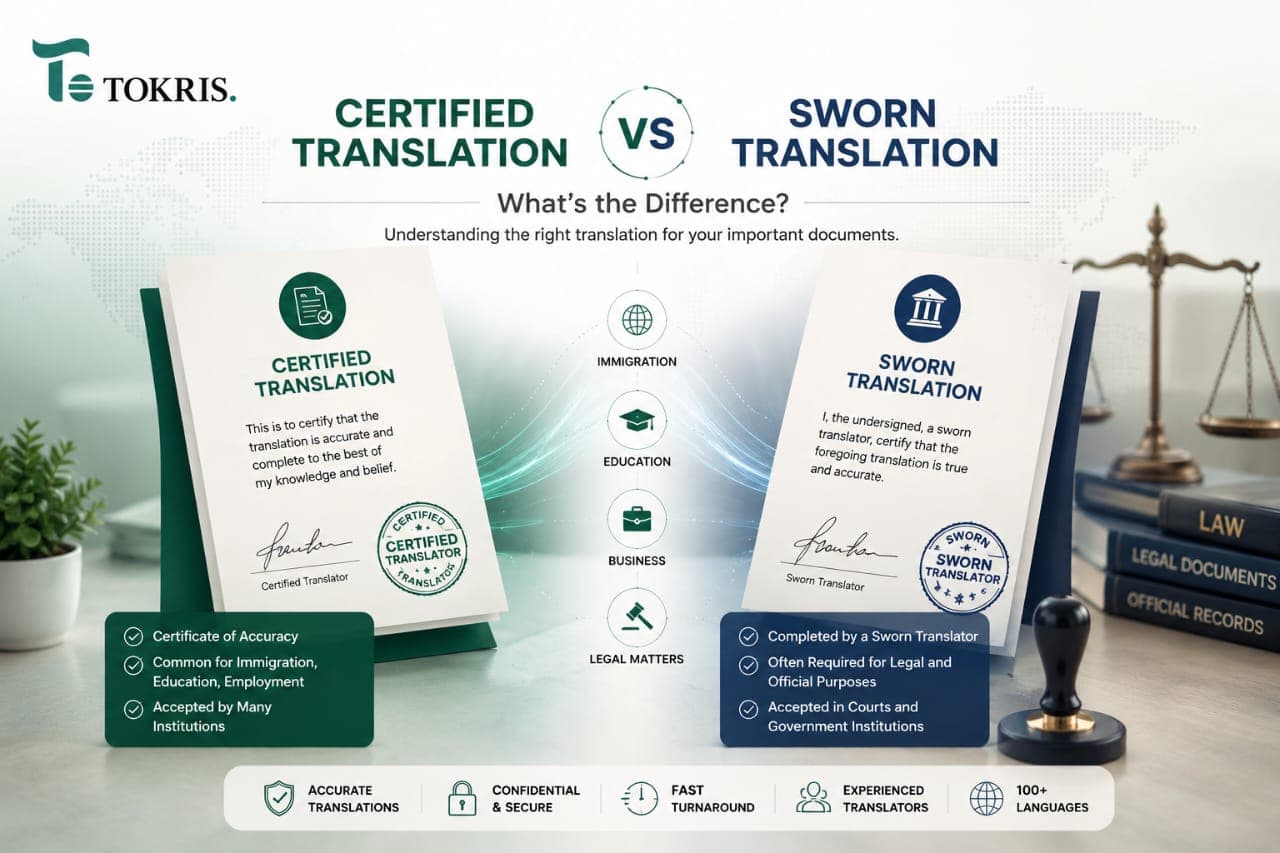
A certified translation generally includes a formal certification or declaration confirming the accuracy and completeness of the translation.
A sworn translation may refer to a translation completed or certified by a translator who has a legally recognized status in a particular country.
A notarized translation involves notarization by a notary public, where required.
The exact requirement depends on the country and authority receiving your documents.
For this reason, it is important to establish what the embassy, immigration authority, university or visa center actually requires before selecting the type of translation.
You can also learn more about the distinction between certified and sworn translation in our guide:
Certified Translation vs Sworn Translation: What's the Difference?
What Languages Can Be Translated for Visa Applications?
Visa documents may need to be translated between many different language combinations.
Common examples include:
· English to French
· English to German
· English to Spanish
· English to Italian
· English to Portuguese
· English to Arabic
· English to Chinese
· English to Czech Republic
· English to Japanese
· English to Korean
· English to Turkish
· English to Dutch
· English to Russian
Documents may also need to be translated from foreign languages into English for use in Nigeria.
At Tokris Global Services, we support translation across 100+ languages, depending on the document and language combination.
What Should You Check Before Translating Your Documents?
Before sending your documents for translation, check the requirements for your particular visa application.
1. Check the official visa requirements
Start with the immigration authority, embassy or official visa application center responsible for your application.
Do not rely solely on information from social media, agents or previous applicants because requirements can change.
2. Check the accepted languages
Find out whether the authority accepts:
· English
· The destination country's official language
· Another specified language
· Multiple languages
3. Check whether certification is required
Some authorities may accept an ordinary translation, while others may specifically require a certified translation or another form of certification.
4. Check whether notarization is required
Do not automatically pay for notarization unless it is required or appropriate for your particular application.
5. Check whether the original document must accompany the translation
Some authorities require the original document together with its translation.
For example, U.S. immigration guidance instructs applicants submitting certified translations to include the translation with the original language document.
6. Check the deadline
Visa applications often have strict submission deadlines. Give yourself enough time for translation, quality review and any additional document preparation that may be required.
Why Professional Visa Document Translation Matters
Visa documents are not the place for incomplete or careless translation.
A small error in a person's name, date, identification number, qualification or other important information can create confusion when documents are reviewed.
Professional translation also helps ensure that the entire document is considered, including relevant information such as:
· Official stamps
· Seals
· Signatures
· Notes
· Dates
· Headings
· Certificates and declarations
· Relevant annotations
The translation should accurately represent the source document rather than simply providing a general summary.
This is particularly important for official documents submitted to government agencies, immigration authorities and other institutions.
Can I Translate My Visa Documents Myself?
It depends on the requirements of the receiving authority.
Even where an authority permits applicants to provide their own translations, professional translation may be preferable for documents containing legal, academic or official information.
Some immigration authorities specifically require a certified translation and a translator's certification statement.
Therefore, before translating your own documents, check whether self translation is permitted for your particular visa application.
If certification is required, using a qualified professional translation provider can help ensure that the required certification is included.
How Tokris Global Services Can Help
At Tokris Global Services, we provide professional language solutions for individuals, students, businesses and organizations in Nigeria and internationally.
Our services include:
· Certified translation
· Sworn translation
· Visa document translation
· Legal document translation
· Academic document translation
· Interpretation
· Transcription
· Localization
· Apostille and legalization support
· Document notarization assistance
We support 100+ languages and handle different types of personal, academic, legal and business documents.
Our process is straightforward.
Step 1: Send Your Documents
Submit clear copies of the documents you need translated through our available contact channels.
Step 2: Document Assessment
We review the documents, language combination and any specific requirements you provide.
Step 3: Receive Your Quote
You receive a quotation based on your document and requirements.
Step 4: Translation and Quality Review
The document is professionally translated and reviewed for accuracy and completeness.
Step 5: Secure Delivery
The completed translation is delivered to you according to the agreed arrangement.
If your application also requires additional document preparation, notarization or legalization support, we can discuss the applicable requirements.
Need Visa Document Translation in Nigeria?
If you are preparing a visa or immigration application and one or more of your documents requires translation, it is better to confirm the requirements before submitting your application.
Tokris Global Services can help you understand your translation requirements and provide professional document translation for visa and international applications.
Send us your document and tell us the destination country and purpose of the application so we can assess the translation requirement and provide the appropriate guidance.
Tokris Global Services Limited
Breaking Language Barriers. Creating Global Opportunities.
Get a Free Quote for your visa document translation today.
Frequently Asked Questions
Do all Nigerian visa applicants need document translation?
No. Translation requirements depend on the destination country, visa category, document language and requirements of the authority handling the application.
Can you translate a Nigerian birth certificate for a visa application?
Yes. Birth certificates are among the types of personal documents that may require professional translation when the receiving authority does not accept the language of the original document.
Do academic certificates need certified translation?
They may, depending on the destination country and the requirements of the institution or immigration authority receiving them.
Is certified translation the same as sworn translation?
Not necessarily. The meaning and legal requirements of these terms can vary between countries and authorities.
How long does visa document translation take?
Turnaround depends on the document, language combination, number of pages and required certification or additional services. Contact Tokris Global Services with your documents for an accurate turnaround estimate.
Can I send my documents online?
Yes. Tokris Global Services accepts document submissions remotely, making it possible to request translation services without visiting an office in person.
Does Tokris translate documents for international applications?
Yes. Tokris Global Services provides professional translation services for visa, immigration, academic, legal, business and other international purposes.
Related articles
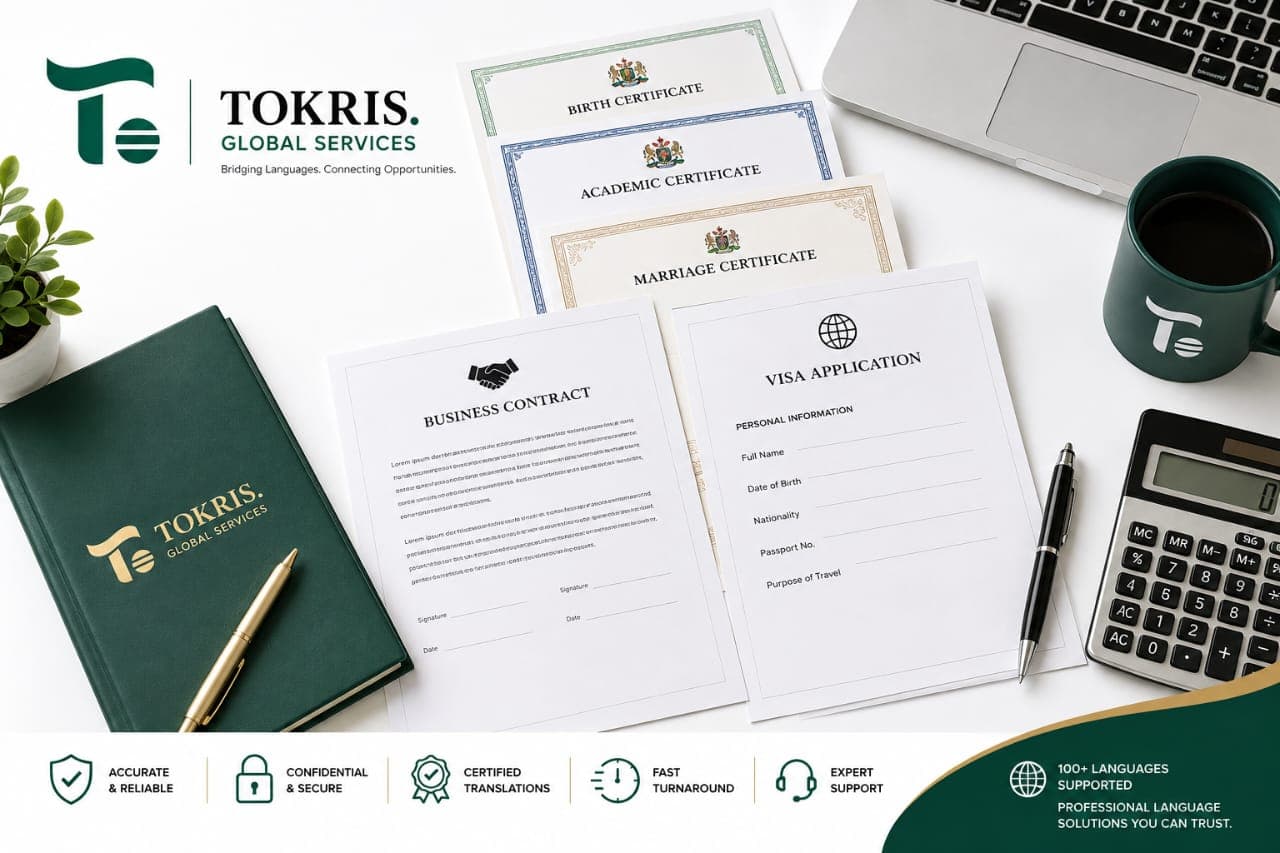
How Much Do Translation Services Cost in Nigeria? A Complete Guide
Wondering how much translation services cost in Nigeria? This guide explains translation rates, pricing per page, certified and sworn translation costs and the factors that determine the final price.
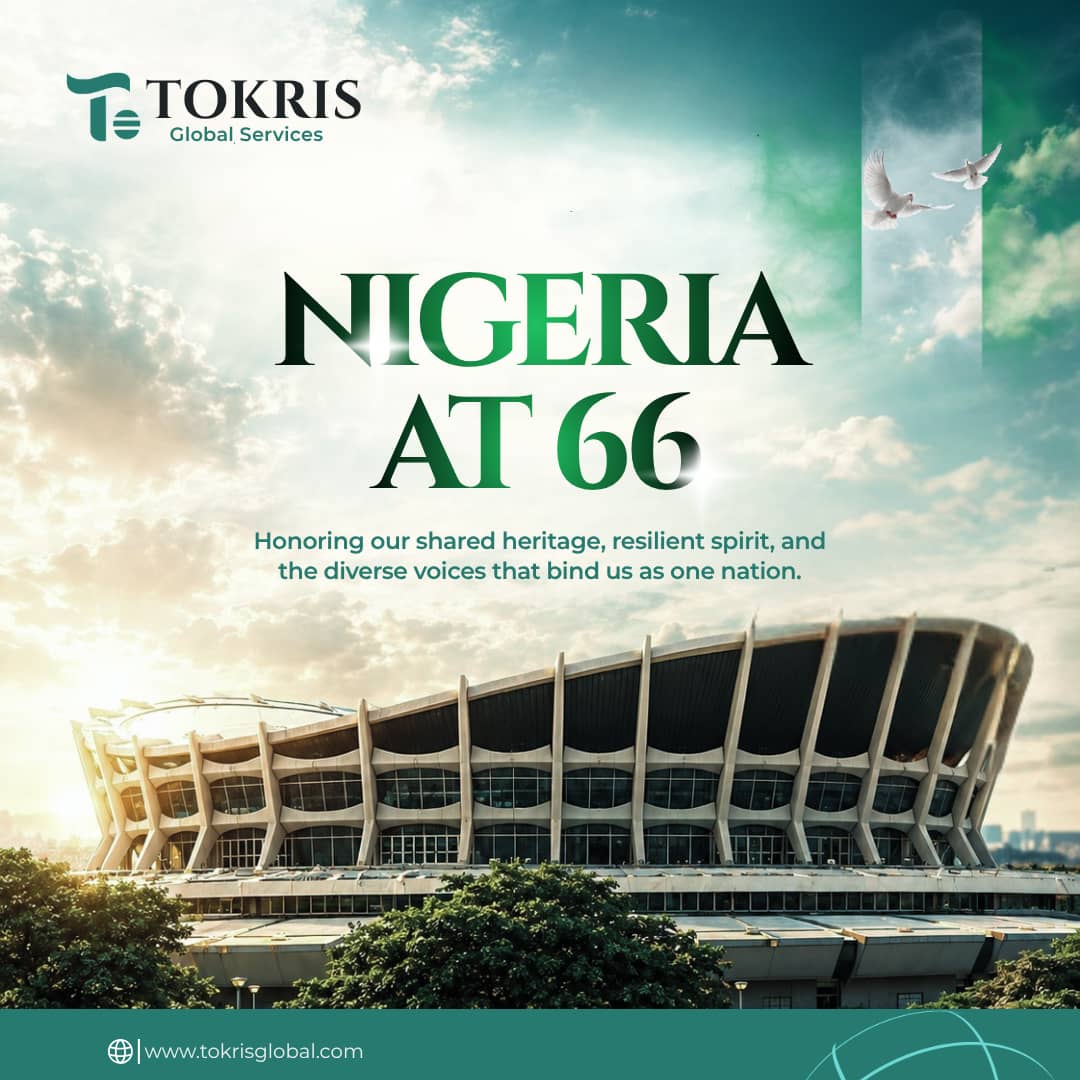
Nigeria at 66: Celebrating Our Diversity and Shared Heritage
Nigeria at 66. Tokris Global Services celebrates Nigeria's independence, diversity, resilience and the many voices that make Nigeria unique. Happy Independence Day. 🇳🇬 Nigeria at 66 Today, we celebrate 66 years of independence and the strength, diversity and resilience that continue to shape our nation. Nigeria became independent on 1 October 1960. � Federal Ministry of Information +1 At TOKRIS Global Services, we celebrate the many languages, cultures and voices that make Nigeria unique.
Certified Translation vs Sworn Translation: What’s the Difference?
Confused about certified and sworn translation? Learn the key differences when each may be required and how to choose the right translation for visas, immigration, education, legal matters and international business.